Smart Human and AI Collaboration Graphics
First Impression: Clean, Confident, and Quietly Human
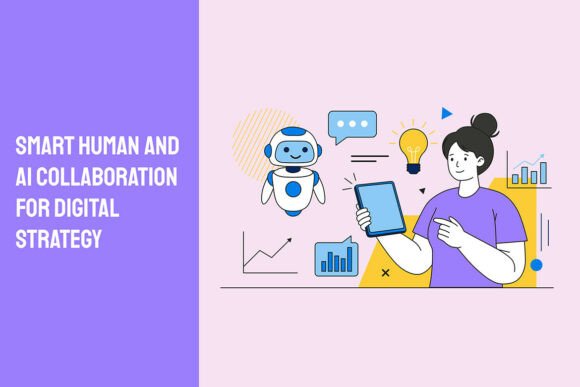
When I opened Smart Human and AI Collaboration for the first time—reviewing it for a local botanical skincare brand launching their refillable serum line—I felt immediate relief. This isn’t flashy AI clipart or sterile tech symbolism. It’s a clean, modern flat illustration with balanced negative space, soft human posture, and an AI assistant rendered as a subtle, glowing interface—not a robot or faceless server rack. The mood is calm competence: approachable but authoritative, warm but precise. It reads as premium without being cold, friendly without sacrificing professionalism. For small business branding, that duality is gold—especially for handmade businesses, wellness brands, or boutique retailers who want to signal innovation *without* alienating customers who value human care.
Where It Fits Like a Custom-Made Label
I tested Smart Human and AI Collaboration across real local business touchpoints—and it earned its place in high-impact spots. On product labels for the serum line, it became a subtle hero graphic beside the “How to Refill” instructions—adding clarity and visual hierarchy without cluttering the ingredient panel. As a decorative element on hang tags and thank-you cards, it reinforced brand identity while keeping tone consistent: thoughtful, intentional, human-led. In packaging design, it worked beautifully as a foil-stamped accent on matte kraft boxes and as a vector-based watermark across printable inserts and social media graphics. It also elevated website banners and Instagram carousel slides—particularly when paired with short copy about “handcrafted formulas, intelligently supported.”
Real Business Benefits—Beyond Aesthetics
- Stronger first impression: Shoppers scanning shelves or scrolling feeds pause at harmony—this illustration signals intentionality, not automation.
- Better product recognition: Used consistently across labels, stickers, and digital ads, it becomes a quiet signature—like a visual footnote to your brand story.
- Clearer visual hierarchy: Its balanced composition naturally guides the eye toward key information (e.g., product name or refill instructions) without competing.
- More consistent brand identity: As a scalable graphic design asset, it bridges digital strategy visuals and physical packaging—no style drift between web and shelf.
- Improved customer trust: For local businesses, showing human + AI collaboration subtly communicates transparency, care, and forward-thinking values—without jargon.
Best Uses: Where This Illustration Earns Its Keep
Smart Human and AI Collaboration shines brightest where clarity meets warmth: product mockups for e-commerce listings, hero graphics for seasonal campaigns (think “Spring Renewal + Smart Skincare”), decorative brand elements on café menu boards, boutique window decals, social media campaign graphics for small business branding workshops, and elegant accents on handmade soap packaging. It’s especially effective in editorial design contexts—like printable newsletters for local makers—or as part of a Canva template kit for creative entrepreneurs managing their own marketing visuals.
Use With Care: Context Is Everything
This isn’t a one-size-fits-all graphic design asset. Avoid placing it directly over legal text areas on food labels or crowded ingredient-heavy layouts—it needs breathing room. It doesn’t translate well to ultra-minimalist luxury branding (think monochrome serif-only identities) or rustic, hand-drawn aesthetics where its clean flatness feels tonally dissonant. Also skip using it on very small labels (<1.5" height) unless you’ve tested the SVG version for crispness—some fine details soften at tiny scales. And never assume PNG transparency works flawlessly on low-contrast backgrounds; always preview on actual packaging mockups.
Practical Brand Designer Notes You’ll Actually Use
- Test it on real packaging mockups—especially matte vs. glossy substrates—to confirm how the flat illustration holds up in print.
- Check black-and-white usage: Does the contrast hold? Will it reproduce clearly on thermal receipt printers or basic inkjet labels?
- Preview it on small labels at 100% scale—don’t rely on screen zoom.
- Test it with your full brand palette: Does it harmonize with earthy tones (for skincare), warm neutrals (for coffee shops), or pastels (for children’s products)?
- Compare side-by-side with top 3 local competitors’ packaging—does it differentiate while feeling category-appropriate?
- Review the SVG file: Are layers editable? Can you isolate the human figure or AI interface for custom color swaps?
- Test typography pairings: Try it beside serif fonts (for elegance), sans serifs (for modern clarity), script fonts (for handmade warmth), and display fonts (for seasonal banners).
- Confirm commercial licensing covers physical product sales—many creative marketplaces restrict use on retail packaging unless explicitly stated.
Final Thought: A Strategic Asset, Not Just Decoration
Smart Human and AI Collaboration isn’t just another illustration—it’s a strategic tool for small business branding. When used intentionally, it helps local businesses communicate sophistication without stiffness, innovation without impersonality, and care without cliché. Whether you’re designing candle labels for a home decor shop, creating social media graphics for a florist’s “AI-Powered Seasonal Picks” campaign, or building a cohesive brand identity for a children’s learning kit, this graphic design asset delivers professional branding weight without demanding heavy design labor. For handmade businesses and creative entrepreneurs, that balance—between human authenticity and smart execution—is exactly what makes Smart Human and AI Collaboration worth more than its download size.